Jika sekadar setinggi langit, ia masih rendah. Kerana cita-cita yang benar-benar hebat dan tinggi ialah; bercita-cita untuk mencintai dan dicintai Pemilik langit. Berusaha untuk mencintaiNya dan berusaha untuk dicintaiNya. Dalam semua, dalam segala, dalam segenap ketika…

“Setelah lama memerap di rumah maka saya cadangkan kepada anak-anak; “Jom kita pi melancong, nak?” Dan anak saya menjawab; “mama, duit yang orang bagi tu lebih baik mama buat kebajikan, misalnya belikan buku-buku untuk kakak, atau kalau nak jalan-jalan pun ke tempat yang budak-budak suka, ni sikit-sikit shopping kompleks, stadium, musium, bangunan-bangunan lama. Cubalah bawa ke gedung mainan, kita orang gembira, mama pun dapat pahala!”. Oh, rupa-rupanya selama ini saya belum cukup membuat kebajikan….”

Kadang-kadang saya lupa yang anak-anak itu ada jiwa, ada kehendak. Kadang-kadang saya membuat sesuatu berdasarkan apa yang saya fikir sebagai seorang ibu. Sedangkan mereka itu adalah anak-anak yang juga mempunyai sudut pandangan mereka sendiri. Semakin mereka membesar, mereka tidak lagi boleh menjadi sekadar penurut perintah, sebaliknya mereka mahu sama-sama melontar pendapat dan menunjuk arah. Tidak salah walaupun kita ibu, kita merendahkan diri kita untuk menerima tunjuk ajar atau paling tidak mendengar apa yang mereka luahkan. Mereka tidak boleh dikatakan kurang ajar jika mereka memandai-mandai menunjuk ajar. Malah suara anak-anaklah sebenarnya yang paling penting untuk didengar dan diteliti, kerana mereka itu umpama rakyat yang diperintah kita, namun nama sahaja kita ini pemerintah akan hakikat sebenarnya kita ini adalah hamba yang bekerja untuk keselesaan mereka. Justeru, gusar apa jika ditegur anak, hatta dikritik sekalipun kerana merekalah juri yang paling valid untuk menilai “siapa diri kita”. Saya bersyukur ke hadrat Allah kerana diberi naluri untuk menyedari hal ini dan bersyukur kerana diberi anak-anak sebagai pemandu dan pengawal segala tingkah laku saya. Mungkin ia adalah hasil bisikan saya yang berterusan ke telinga mereka; “wahai anak-anak mama, mama ini manusia yang penuh dengan kelemahan. Jika mama salah, tegurlah mama, mama tidak marah. Jika mama betul, ikutlah mama, dan mama akan teramat gembira. Jangan ikut apa yang mama buat atau kata jika anak-anak tahu ianya adalah salah sekalipun mama ini ibumu. Yang penting, bukan status siapa yang berkata tetapi apa yang mereka kata. Jika kata-kata itu benar, sekalipun ianya keluar dari mulut orang lain, maka ambillah ia sebagai nasihat atau ikutan, akan tetapi jika kata-kata itu dusta, abaikan dan jadikanlah sempadan sekalipun ia terlontar dari mulut manis mamamu. Jika mama silap, ampunkan mama dan pandulah mama ke jalan yang benar.”

Alhamdulillah, hasilnya adalah kebaikan kerana hampir di setiap kali kealpaan, anak-anak akan menegur saya tanpa rasa takut. “Mama dah solat belum? Adik rasa mama belum solat, dari tadi asyik depan laptop”, “Tak baik mama marah-marah macam tu kat Abdullah, bukan ke Abdullah kecil lagi?”, “Mama suruh kita ngaji tapi mama tak ngaji pun”, “Bila kakak minta beli buku, mama kata takde duit, tapi kakak tengok mama beli baju baru”, dan sebagainya adalah antara teguran-teguran yang menginsafkan tanpa melukakan hati saya. Kerana kanak-kanak adalah amat ikhlas dalam mengekpresikan sesuatu, mereka tidak mempunyai kepentingan peribadi, mereka menasihati dari lubuk hati mereka yang sungguh suci. Dan nasihat itu kerana ianya sungguh ikhlas, maka ia terus sampai ke jiwa dan roh kita tanpa waswas, tanpa prejudis, tanpa perlu berkecil hati atau menderita menanggung jiwa yang panas.

Oleh yang demikian, saya sangat mengambil berat akan setiap kata-kata anak terhadap saya dan saya sanggup berhenti bercakap dengan sesiapa jua jika anak-anak menunjukkan isyarat untuk memberitahu saya sesuatu. Saya percaya bahawa; Kita perlu belajar daripada anak-anak lebih daripada kita perlu mengajar mereka!

Gambar diambil di hari raya 2011.


Aku ini hambaNya yang banyak terkhilaf dalam kehidupan. Apabila terasa diri telah jauh menyimpang, aku mahu pulang, mencari Tuhan dan mencari diri yang hilang. Moga aku tidak tergelincir lagi di landasan yang sedang ku berdiri ini dan moga di hujungnya adalah redha Ilahi. Adapun, hasil daripada menemui semula jalan pulang maka aku berasakan bahawa ramadhan kali ini adalah ramadhanku yang paling wangi. Nikmat bertadarus bersama zuriat sendiri, nikmat bertarawih dengan kekusyukkan hati dan nikmat memburu qadr di malam sunyi adalah antara nikmat-nikmat yang baru kini aku mengecapi, setelah bergelar suri. Adapun ramadhan-ramadhan yang lepas, hidupku agak kusut dengan pengajian, kelahiran dan anak-anak yang masih di kendongan. Kini ketiga-tiga mereka telah besar, dan sudah mampu berdikari. Malah di dalam diri mereka juga sudah mula datang keinginan-keinginan untuk mengenal diri sendiri dan keinginan untuk memperhambakan diri kepada Ilahi. Sama sepertiku, mereka juga mengharapkan yang serupa; Ramadhan yang paling wangi antara ramadhan-ramadhan yang wangi!


Narrated Ibn ‘Umar: The Prophet ordered the people to pay Zakat-ul-Fitr before going to the ‘Id prayer. (Sahih Bukhari)

Narrated Ibn Umar: Allah’s Apostle enjoined the payment of one Sa’ of dates or one Sa’ of barley as Zakat-ul-Fitr on every Muslim slave or free, male or female, young or old, and he ordered that it be paid before the people went out to offer the ‘Id prayer. (One Sa’ = 3 Kilograms approx.)  (Sahih Bukhari)

Narrated Ibn ‘Umar: Allah’s Apostle made it incumbent on all the slave or free Muslims, male or female, to pay one Sa’ of dates or barley as Zakat-ul-Fitr. (Sahih Bukhari)

Narrated Abu Said Al-Khudri: We used to give one Sa’ of meal or one Sa’ of barley or one Sa’ of dates, or one Sa’ of cottage cheese or one Sa’ of Raisins (dried grapes) as Zakat-ul-Fitr.  (Sahih Bukhari)

Narrated ‘Abdullah bin ‘Umar The Prophet ordered (Muslims) to give one Sa’ of dates or one Sa’ of barley as Zakat-ul-Fitr. The people rewarded two Mudds of wheat as equal to that.  (Sahih Bukhari)

Narrated Abu Sa’id Al-Khudri: In the life-time of the Prophet we used to give one Sa’ of food or one Sa’ of dates or one Sa’ of barley or one Sa’ of Raisins (dried grapes) as Sadaqat-ul-Fitr. And when Muawiya became the Caliph and the wheat was (available in abundance) he said, “I think (observe) that one Mudd (of wheat) equals two Mudds (of any of the above mentioned things).  (Sahih Bukhari)

Narrated Abu Said Al-Khudri: In the life-time of Allah’s Apostle , we used to give one Sa’ of food (edible things) as Sadaqat-ul-Fit,r (to the poor). Our food used to be either of barley, raisins (dried grapes), cottage cheese or dates. (Sahih Bukhari)

Narrated Nafi’: Ibn ‘Umar said, “The Prophet made incumbent on every male or female, free man or slave, the payment of one Sa’ of dates or barley as Sadaqat-ul-Fitr (or said Sadaqa-Ramadan).” The people then substituted half Sa’ of wheat for that. Ibn ‘Umar used to give dates (as Sadaqat-ulFitr). Once there was scarcity of dates in Medina and Ibn ‘Umar gave barley. ‘And Ibn ‘Umar used to give Sadaqat-ul-Fitr for every young and old person. He even used to give on behalf of my children. Ibn ‘Umar used to give Sadaqatul-Fitr to those who had been officially appointed for its collection. People used to give Sadaqat-ul-Fitr (even) a day or two before the ‘Id.  (Sahih Bukhari)

Narrated Ibn ‘Umar: Allah’s Apostle has made Sadaqatul-Fitr obligatory, (and it was), either one Sa’ of barley or one Sa’ of dates (and its payment was obligatory) on young and old people, and on free men as well as on slaves.(Sahih Bukhari)


Narrated Ibn Abbas: The Prophet said, “Look for the Night of Qadr in the last ten nights of Ramadan ,’ on the night when nine or seven or five nights remain out of the last ten nights of Ramadan (i.e. 21, 23, 25, respectively).”  (Sahih Bukhari)

Narrated Ibn ‘Abbas: Allah’s Apostle said, “The Night of Qadr is in the last ten nights of the month (Ramadan), either on the first nine or in the last (remaining) seven nights (of Ramadan).” Ibn ‘Abbas added, “Search for it on the twenty-fourth (of Ramadan).”  (Sahih Bukhari)

Narrated ‘Ubada bin As-Samit: The Prophet came out to inform us about the Night of Qadr but two Muslims were quarreling with each other. So, the Prophet said, “I came out to inform you about the Night of Qadr but such-and-such persons were quarreling, so the news about it had been taken away; yet that might be for your own good, so search for it on the 29th, 27th and 25th (of Ramadan).  (Sahih Bukhari)

Narrated Abu Said Al-Khudri: Allah’s Apostle used to practice Itikaf (in the mosque) in the middle third of Ramadan and after passing the twenty nights he used to go back to his house on the 21st, and the people who were in Itikaf with him also used to go back to their houses. Once in Ramadan, in which he practiced Itikaf, he established the night prayers at the night in which he used to return home, and then he addressed the people and ordered them whatever Allah wished him to order and said, “I used to practice Itikaf for these ten days (i.e. the middle 113rd but now I intend to stay in Itikaf for the last ten days (of the month); so whoever was in Itikaf with me should stay at his place of seclusion. I have verily been shown (the date of) this Night (of Qadr) but I have forgotten it. So search for it in the odd nights of the last ten days (of this month). I also saw myself (in the dream) prostrating in mud and water.” On the night of the 21st, the sky was covered with clouds and it rained, and the rain-water started leaking through the roof of the mosque at the praying place of the Prophet . I saw with my own eyes the Prophet at the completion of the morning prayer leaving with his face covered with mud and water.  (Sahih Bukhari)


Narrated ‘Aisha: Allah’s Apostle said, “Search for the Night of Qadr in the odd nights of the last ten days of Ramadan.” 

(Sahih Bukhari)

Narrated ‘Aisha: Allah’s Apostle used to practice Itikaf in the last ten nights of Ramadan and used to say, “Look for the Night of Qadr in the last ten nights of the month of Ramadan ,” 

(Sahih Bukhari)

Narrated Aisha: With the start of the last ten days of Ramadan, the Prophet used to tighten his waist belt (i.e. work hard) and used to pray all the night, and used to keep his family awake for the prayers.

(Sahih Bukhari)


Narrated Abdullah ibn Umar: Marwan ibn Salim al-Muqaffa’ said:

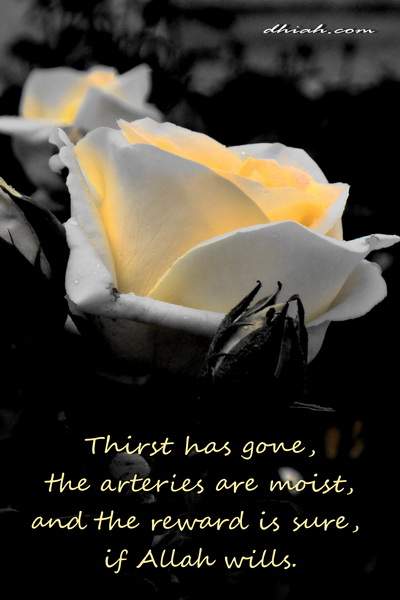
I saw Ibn Umar holding his bread with his hand and cutting what exceeded the handful of it. He (Ibn Umar) told that the Prophet (peace_be_upon_him) said when he broke his fast: Thirst has gone, the arteries are moist, and the reward is sure, if Allah wills.

(Sunan Abu-Dawud)


‘A’isha (Allah be pleased with her) said that the Messenger of Allah (may peace be upon him) kissed one of his wives while he was fasting, and then she (‘A’isha) smiled (as she narrated).  (Sahih Muslim)

Sufyan reported: I said to ‘Abd al-Rahman b. Qasim: Have you heard from your father narrating from ‘A’isha (Allah be pleased with her) that he kissed her while observing fast? He (‘Abd al-Rahman b. Qasim) kept silence for a short while and then said:” Yes.”  (Sahih Muslim)

‘A’isha reported: Allah’s Messenger (may peace be upon him) used to kiss me while observing fast; and who among you can control his desire as the Messenger of Allah (may peace be upon him) could control his desire.  (Sahih Muslim)

‘A’isha (Allah be pleased with her) reported: Allah’s Messenger (may peace be upon him) used to kiss (his wives) while fasting and embraced (them) while fasting; but he had the greatest mastery over his desire among you. (Sahih Muslim)

Yahya related to me from Malik from Zayd ibn Aslam from Ata ibn Yasar that a certain man kissed his wife while he was fasting in Ramadan. This made him very anxious, and so he sent his wife to the Prophet, may Allah bless him and grant him peace, to ask him about that for him. She went in and saw Umm Salama, the wife of the Prophet, may Allah bless him and grant him peace, and mentioned the matter to her, and Umm Salama told her that the Messenger of Allah, may Allah bless him and grant him peace, used to kiss while he was fasting. So she went back and told her husband that, but it only made him find fault all the more and he said, “We are not like the Messenger of Allah, may Allah bless him and grant him peace. Allah makes permissible for theMessenger of Allah, may Allah bless him and grant him peace, whatever He wishes.” His wife then went back to Umm Salama and found the Messenger of Allah, may Allah bless him and grant him peace, with her. The Messenger of Allah, may Allah bless him and grant him peace, said, “What’s the matter with this woman?”, and Umm Salama told him. The Messenger of Allah, may Allah bless him and grant him peace, said, “Didn’t you tell her that I do that myself?” and she said, “I told her, and she went to her husband and told him, but it only made him find fault all the more and say, ‘We are not like the Messenger of Allah, may Allah bless him and grant him peace. Allah makes permissible for His Messenger, may Allah bless him and grant him peace, whatever He wishes.’ ” The Messenger of Allah, may Allah bless him and grant him peace, got angry and said, “By Allah, I am the one with the most taqwa of Allah of you all, and of you all the one who best knows His limits.” (Malik’s Muwatta)

Yahya related to me from Malik from Abu’n-Nadr, the mawla of Umar ibn Ubaydullah that A’isha bint Talha told him that she was once with A’isha, the wife of the Prophet, may Allah bless him and grant him peace, and her husband, who was fasting, came and visited her there. (He was Abdullah ibn Abd ar-Rahman ibn Abi Bakras-Siddiq.) A’isha said to him, “What’s stopping you from coming close to your wife and kissing her and joking with her?” He said, “Can I kiss her when I am fasting?” She said, “Yes.”  (Malik’s Muwatta)

Yahya related to me from Malik from Zayd ibn Aslam from Ata ibn Yasar, that Abdullah ibn Abbas was asked about people kissing while fasting and he said that he allowed it for old men but disapproved of it for young men. (Malik’s Muwatta)


Yahya related to me from Malik from Abu’z Zinad from al-Araj from Abu Hurayra that the Messenger of Allah, may Allah bless him and grant him peace, said,

“By the One in Whose hand my self is, the smell of the breath of a man fasting is better with Allah than the scent of musk.’ He leaves his desires and his food and drink for My sake. Fasting is for Me and I reward it. Every good action is rewarded by ten times its kind, up to seven hundred times, except fasting, which is for Me, and I reward it.” 

(Malik’s Muwatta)


Narrated Abu Huraira: The Prophet said,

“Whoever established prayers on the night of Qadr out of sincere faith and hoping for a reward from Allah, then all  his previous sins will be forgiven; and whoever fasts in the month of Ramadan  out of sincere faith, and hoping for a reward from Allah, then all his previous  sins will be forgiven.” 

(Sahih Bukhari)


Related Posts Plugin for WordPress, Blogger...